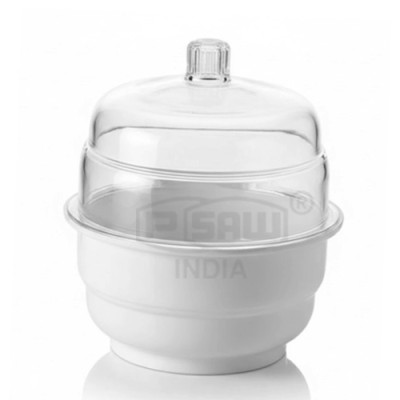
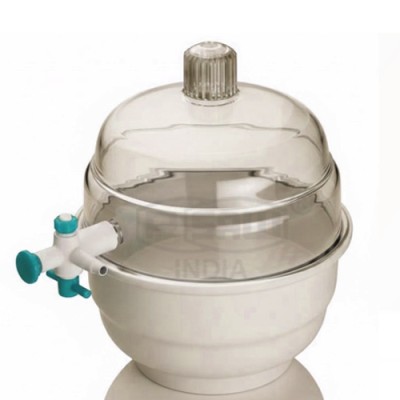
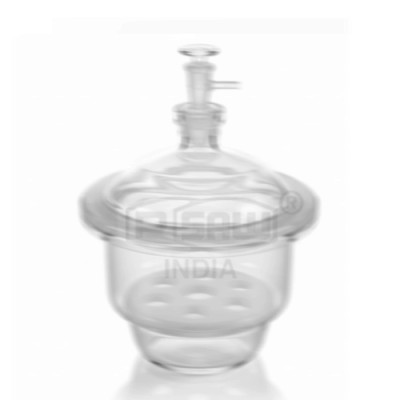
Accurate scientific measurement demands an environment free from atmospheric interference. Water vapor present in ambient air can alter dry sample weights, degrade active pharmaceutical ingredients (APIs), and cause irreversible hydration in anhydrous chemicals.
To prevent atmospheric moisture contamination, research institutes, university laboratories, and testing facilities worldwide rely on laboratory glassware desiccators.
Popular Science Apparatus Workshops Pvt. Ltd. (PSAW INDIA), established in Ambala, Haryana, has been a leading manufacturer and exporter of scientific laboratory equipment and high-precision borosilicate glassware for decades. Engineered with strict adherence to global scientific and safety protocols, PSAW INDIA desiccators deliver mechanical strength, thermal shock resistance, and airtight seals.
+---------------------------------------------------+
|               PSAW Grounded Glass Lid             |
|           (With PTFE Stopcock for Vacuum)         |
+---------------------------------------------------+
|          Precision Ground Glass Flange            |
|         (Hermetically Sealed with Grease)         |
+---------------------------------------------------+
|               Sample Chamber Area                 |
|       (Crucibles / Dishes on Porcelain Plate)     |
+---------------------------------------------------+
|             PSAW Desiccant Base Reservoir         |
|      (Silica Gel / Anhydrous CaCl2 / Sieves)      |
+---------------------------------------------------+
2. What is a Laboratory Glassware Desiccator?
A laboratory glassware desiccator is an enclosed glass vessel designed to absorb atmospheric moisture within its chamber. Unlike a drying oven that actively applies high heat to evaporate liquids, a desiccator provides a passive, low-humidity storage environment or an accelerated low-pressure drying area.
Primary Purpose:
-
Drying Samples: Removing micro-trace water content from solid compounds.
-
Cooling Heated Vessels: Allowing hot crucibles or ignition dishes from ovens to cool to room temperature without re-absorbing humidity before mass measurement.
-
Preserving Reagents: Storing hygroscopic salts, standard reference chemicals, and active drug ingredients safely.
3. Working Principle of Glass Desiccators
The operation of a PSAW INDIA glass desiccator rests on chemical absorption equilibrium and physical vacuum dynamics:
Passive Vapor Absorption (Standard Desiccators)
- The bottom basin holds a chemical desiccant with a strong affinity for water vapor.
- When the lid is slid closed, the ground-glass flange creates a seal.
- Moisture inside the trapped air migrates toward the desiccant until equilibrium is established near relative humidity (RH).
Reduced Pressure Extraction (Vacuum Desiccators)
- A vacuum pump connects to the top stopcock valve of the PSAW vacuum desiccator.
- Evacuating air lowers atmospheric pressure within the chamber, accelerating liquid evaporation and pulling trapped moisture out of porous matrices without applying heat.
4. Key Components of PSAW INDIA Glass Desiccators
Every desiccator unit produced by Popular Science Apparatus Workshops Pvt. Ltd. (PSAW INDIA) consists of key structural elements designed for long service life and user safety:
| Component |
Engineering Details |
Technical Function |
| Borosilicate Glass Body |
Formed from heavy-wall Borosilicate 3.3 Glass. |
Offers maximum thermal resistance, structural thickness, and chemical inertness. |
| Ground Glass Flange |
Precision-ground mating surfaces on base and lid. |
Provides a seamless, vacuum-tight joint when lubricated. |
| Porcelain Perforated Plate |
Highly glazed, chemical-resistant ceramic plate. |
Holds samples elevated above the desiccant while allowing airflow through perforations. |
| Desiccant Compartment |
Lower deep basin base below the plate support rim. |
Houses silica gel, anhydrous calcium chloride, or molecular sieves. |
| PTFE / Glass Stopcock |
Ground-glass valve with leak-proof plug (Vacuum models). |
Controls air evacuation and pressure equalization. |
5. Types of Glass Desiccators Offered by PSAW INDIA
- Mechanism: Uses passive desiccant absorption inside a sealed static chamber.
- Common Diameters: 150 mm, 200 mm, 250 mm, and 300 mm.
- Best Applications: Standard storage of dry reagents, routine crucible cooling, and qualitative moisture control.
- Key Advantage: Simple setup, cost-effective, and independent of external vacuum pumps.
2. PSAW Vacuum Glass Desiccators
- Mechanism: Equipped with a heavy-duty stopcock on the lid to connect to a manual or motor vacuum pump.
- Common Diameters: 150 mm, 200 mm, 250 mm, and 300 mm.
- Best Applications: Rapid moisture extraction, vacuum drying of thermal-sensitive biological samples, and air-free storage.
- Key Advantage: Rapid drying rates and deeper internal humidity reduction.
6. Comparison Table: Vacuum vs. Non-Vacuum Desiccators
| Feature Parameter |
PSAW Non-Vacuum Desiccator |
PSAW Vacuum Desiccator |
| Pressure Environment |
Ambient atmospheric pressure |
Reduced pressure / Negative vacuum environment |
| Top Attachment |
Standard solid glass knobbed lid |
Ground-glass stopcock with valve tube |
| Drying Rate |
Standard / Passive |
Accelerated / Active |
| Air Removal |
No |
Yes (Air and volatile gases extracted) |
| Primary Focus |
Routine storage & crucible cooling |
Deep drying & air-sensitive sample handling |
7. Desiccants Used in PSAW Laboratory Glassware
Selecting the right chemical desiccant is essential to maintain optimal low-humidity performance inside your Popular Science Apparatus Workshops Pvt. Ltd. desiccator:
+-------------------+--------------------+-------------------------------------------+
| Chemical Agent    | Color Indicator    | Regeneration / Care                       |
+-------------------+--------------------+-------------------------------------------+
| Indicating Silica | Blue (Active)      | Bake in lab oven at 120°C - 150°C       |
| Gel               | Pink (Saturated)   | until original blue returns.              |
+-------------------+--------------------+-------------------------------------------+
| Anhydrous CaCl2   | White Granules     | Heat at 200°C; low cost for general use.  |
+-------------------+--------------------+-------------------------------------------+
| Molecular Sieves  | Tan / Brown Beads  | Regenerate at 250°C - 300°C for ultra-low |
|                   |                    | residual moisture levels.                 |
+-------------------+--------------------+-------------------------------------------+
8. Industrial and Research Applications of PSAW Desiccators
1. Analytical Chemistry & Gravimetric Analysis
In quantitative analysis, mass accuracy is paramount. When heating a sample in a furnace to drive off organic matter, the remaining inorganic residue in the crucible must cool before weighing. Placing the hot crucible directly on a balance creates thermal draft errors, while cooling it in open air causes water absorption. A PSAW borosilicate Desiccator with Lid, Plain allows safe thermal cooling in a zero-moisture environment.
2. Pharmaceutical R&D and Quality Control
Pharmaceutical active ingredients (APIs), biological standards, and tableting powders degrade or clump when exposed to humidity. Popular Science Apparatus Workshops Pvt. Ltd. supplies laboratory glassware engineered to safeguard chemical stability against hydrolysis.
3. Material Science & Polymer Engineering
Synthesis of advanced polymers, catalytic powders, hygroscopic nanostructures, and electronic substrates requires complete isolation from atmospheric water vapor prior to physical characterization.
9. Standard Operating Procedure (SOP): How to Use a PSAW Glass Desiccator
To ensure safe operation and long equipment life, follow this SOP when handling PSAW INDIA desiccators:
Step 1: Inspection & Preparation
- Inspect the borosilicate glass surface for scratches, hairline cracks, or rim chips.
- Clean the interior lower base with a dry lint-free cloth.
Step 2: Filling the Desiccant Base
- Pour fresh, activated desiccant (e.g., active blue silica gel) into the bottom base reservoir.
- Ensure the desiccant level remains well below the support ledge for the porcelain plate.
Step 3: Installing the Porcelain Plate
- Gently lower the perforated porcelain plate onto the internal glass ledge.
- Ensure the plate lies completely flat and stable.
Step 4: Applying Vacuum Sealant
- Apply a thin, uniform coating of high-vacuum silicone grease along the ground glass flange rim of the base.
Step 5: Loading Samples and Closing Lid
- Place crucibles or sample containers onto the porcelain plate.
- Position the lid onto the base rim and slide it horizontally into place to spread the vacuum grease evenly and establish an airtight seal.
 CORRECT WAY: Horizontal Sliding
 [  PSAW GLASS LID  ]  ========>
 [  DESICCATOR BASE ]

 INCORRECT WAY: Vertical Lifting
 [  PSAW GLASS LID  ]  ^
                       |
 [  DESICCATOR BASE ]
10. Safety Rules & Maintenance Best Practices
- Always Slide the Lid Horizontally: Never lift a glass desiccator lid vertically upward. Lifting vertically can pick up the entire base due to grease suction, risking drops and breakage.
- Handling Hot Crucibles: When placing hot crucibles into the desiccator, leave the lid slightly open or open the stopcock briefly for 10–20 seconds. Air expanded by heat will escape, preventing an internal vacuum from locking the lid upon cooling.
- Depressurizing Vacuum Units: Always open the PTFE stopcock slowly to break the internal vacuum. Rushing air inside can scatter light powders across the interior chamber.
- Carrying Protocol: Support the bottom base with one hand while holding the top lid knob securely with the other. Never carry a desiccator by its top lid handle alone.
11. Why Popular Science Apparatus Workshops Pvt. Ltd. (PSAW INDIA) is the Industry Choice
Selecting the right scientific manufacturer ensures reliability, safety, and compliance with international standards. Popular Science Apparatus Workshops Pvt. Ltd. stands out as a leading laboratory glassware manufacturer due to:
- Borosilicate 3.3 Glass Grade: Superior chemical resistance against acids, alkalis, and organic solvents.
- Thermal & Mechanical Durability: Heavy-wall construction engineered to handle vacuum pressure stress and thermal changes without fracturing.
- Flange Sealing: Mating ground flanges are precision-finished for leak-free performance.
- Comprehensive Product Range: Available in sizes from 150mm up to 300mm in both vacuum and plain non-vacuum formats.
- Quality Assurance: ISO-compliant manufacturing processes with quality control testing across all glassware ranges.
Frequently Asked Questions
Q1: Why should I choose PSAW INDIA glass desiccators over plastic alternatives?
Borosilicate 3.3 glass desiccators from Popular Science Apparatus Workshops Pvt. Ltd. offer higher chemical resistance, superior scratch resistance, high transparency, and full safety when handling hot crucibles compared to acrylic or plastic units.
Q2: How do I open a stuck PSAW desiccator lid?
If the vacuum grease hardens and locks the lid, ensure the stopcock is fully open to equalize internal pressure. If it remains stuck, slide a thin, soft plastic spatula carefully between the greased flange rims to break the vacuum seal without scratching the ground glass.
Q3: What is the ideal grease for PSAW desiccator ground glass flanges?
A high-vacuum silicone grease or PTFE-based lubricant should be used. Avoid petroleum jelly (vaseline) for high-vacuum applications as it breaks down under reduced pressures.
Q4: How frequently should silica gel desiccant inside a glass desiccator be changed?
When using cobalt-indicating silica gel, the material should be regenerated as soon as 60–70% of the beads turn from blue to pink.
Key Recommendations for Laboratory Professionals
To maximize the lifespan and operational efficiency of your Popular Science Apparatus Workshops Pvt. Ltd. (PSAW INDIA) glassware desiccators, always follow strict standard operating procedures. Ensure that only high-vacuum grade silicone grease is applied evenly to the precision ground flanges for a seamless seal, and always slide the lid horizontally—never lift it vertically—to prevent accidental drops or structural damage. For quantitative analytical tasks, monitor desiccant saturation regularly and regenerate silica gel as soon as the color indicator shifts to pink. When working with hot crucibles, briefly vent the chamber using the stopcock to prevent internal pressure differential buildup. By pairing PSAW INDIA’s heavy-duty Borosilicate 3.3 glass desiccators with proper handling and routine maintenance, research and industrial laboratories can ensure reliable moisture control, consistent sample mass precision, and long-term operating safety.