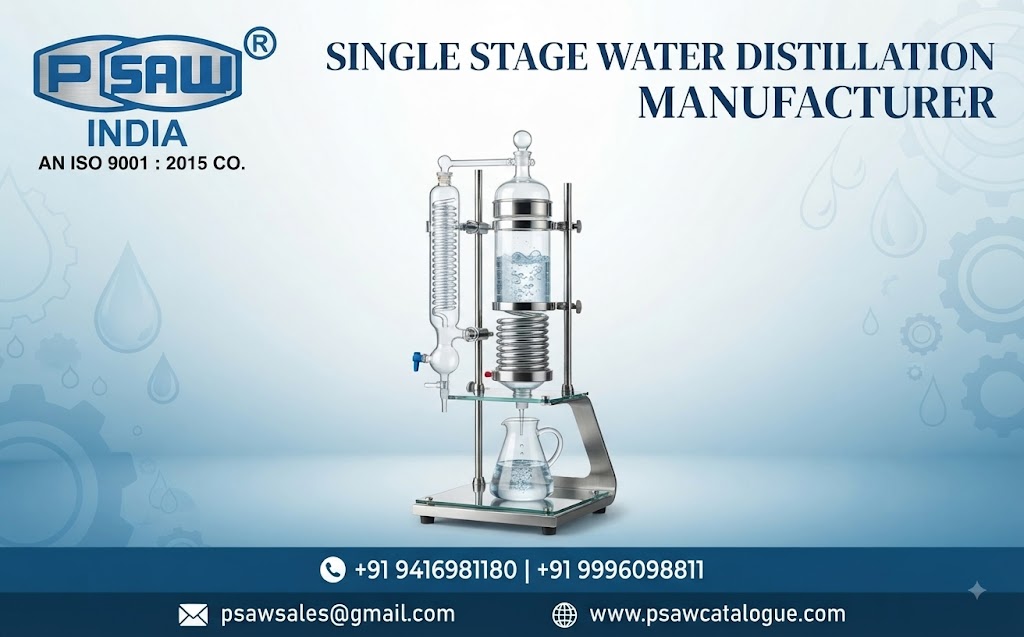
Water Distillation Units: Pure Water Solutions for Laboratories & Industrial Needs
In an era where water purity determines the success of scientific experiments, pharmaceutical formulations, and high-precision manufacturing, settling for average water quality is not an option. Contaminants, dissolved minerals, heavy metals, and micro-organisms present in tap or municipal water can compromise sensitive research, invalidate laboratory testing, and degrade equipment performance over time.
Enter the water distillation unit—a trusted workhorse of chemical laboratories, medical facilities, and industrial units worldwide. By utilizing thermal evaporation and condensation, modern distillation systems deliver high-purity, contaminant-free water.
In this comprehensive guide, we explore everything you need to know about choosing, using, and optimizing a laboratory water distillation unit, the engineering behind a steam distillation water purifier, and how industry leaders like psaw India are shaping modern liquid purification technology.
What is a Water Distillation Unit and How Does It Work?
A water distillation unit is a specialized thermal purification system designed to separate pure H2O molecules from impurities, dissolved solids, heavy metals, organic compounds, and biological pathogens.
Unlike conventional mechanical filtration methods that rely on physical barriers or membranes (such as Reverse Osmosis), distillation replicates Earth’s natural hydrologic cycle:
- Evaporation (Boiling): Source water is heated to its boiling point inside a high-grade heating chamber. As water turns to steam, non-volatile contaminants, minerals, salts, and heavy metals are left behind.
- Separation: The vapor rises into a condensation tube or coil, leaving heavy contaminants in the boiling vessel.
- Condensation (Cooling): The clean steam passes through a condenser cooled by air or water, where it turns back into high-purity liquid water.
- Collection: The purified distillate is collected into a sterile storage tank ready for immediate use.
Because impurities do not evaporate at the boiling point of water, a high-quality water distillation unit consistently produces pure, chemical-free distillate suitable for strict laboratory standards.
Types of Water Distillation Equipment
Depending on your application, volume demands, and structural requirements, distillation technology is categorized into specific configurations.
1. Laboratory Water Distillation Unit
Specifically engineered to comply with demanding analytical standards such as ASTM Type II and Type III water purity requirements.
- Reagent & buffer preparations
- Microbiological culture preparation
- Analytical glassware cleaning
- AAS and HPLC instrumental analysis
2. Lab Water Distillation Unit (Compact)
A compact lab water distillation unit optimized for benchtop usage in clinical labs, universities, and research facilities.
- Space-saving bench/wall mount design
- Automatic power cut-offs for safety
- Plug-and-play quick setup
3. Steam Distillation Water Purifier
A steam distillation water purifier utilizes advanced steam-separation technology to handle challenging feed water with high TDS levels.
- Multi-stage high efficiency coils
- Integrated VOC gaseous vents
- Ideal for Pharma & Battery manufacturing
Critical Advantages of Water Distillation Units
| Purity Parameter |
Water Distillation Performance |
| Heavy Metals Removal |
Up to 99.9% (Lead, Mercury, Arsenic, Cadmium) |
| Dissolved Solids (TDS) |
Reduced to near zero levels |
| Micro-organisms |
100% elimination of Bacteria, Viruses, and Spores |
| Organic Contaminants |
High reduction of non-volatile organic matter |
| Maintenance Complexity |
Low (No membrane replacements required) |
Unlike Reverse Osmosis systems that require frequent pre-filter and membrane replacements due to biofouling or scaling, a lab water distillation unit relies on durable heating elements and condenser tubes. In contrast, a steam distillation water purifier maintains uniform distillate purity continuously throughout its operating lifespan.

Featured Water Distillation Equipment
Explore high-performance water distillation models engineered by psaw India
Single Stage Quartz Boiler Distillation
Quartz Boiler & Borosilicate Condenser (Vertical Model without safety cutoff).
Double Stage Water Distillation (Horizontal)
All Glass Horizontal Model equipped with inbuilt safety cutoff.
Automatic Water Distillation (Cabinet Still)
Fully automatic cabinet unit with modern thermal cut-outs and control.
Single Stage Water Distillation Unit
Standard benchtop solution for everyday general laboratory applications.
Double Stage Water Distillation Unit
High-purity dual-pass setup for rigorous scientific and clinical research.
Water Distillation Cabinet Still
Compact cabinet design offering safety, reliability, and ease of operation.
Alcohol Distillation Apparatus
Precision distillation setup tailored for chemical labs and alcohol testing.
RM Value Apparatus
Specialized analytical distillation unit for Reichert-Meissl value testing.
Industrial Water Softener Plant
Pre-treatment systems engineered to extend distillation unit operating life.
Key Features to Consider Before Buying
Selecting the right distillation setup for your facility requires evaluating several key operational parameters:
1. Construction Material
- Borosilicate Glass: Ideal for trace analysis and chemical research because of its chemical inertness and zero metal leaching.
- Stainless Steel (SS 316L): Preferred for heavy-duty commercial labs, medical sterilization, and pharmaceutical plants due to high impact resistance and longevity.
- Quartz: Used in ultra-pure applications where metal trace elements must be strictly non-existent.
2. Distillation Capacity (Liters Per Hour - LPH)
- Small Research Labs / Clinics: 2 to 4 LPH
- Medium Testing Facilities: 8 to 12 LPH
- Industrial & Pharmaceutical Plants: Multi-stage units delivering 20 to 100+ LPH
3. Built-In Safety & Automation Features
- Low-Water Level Cut-Off: Protects heating elements from dry burning.
- Over-Temperature Protection: Prevents thermal damage to internal components.
- Automatic Feed Control: Regulates raw water intake based on distillate production rates.
Comparing Purification Methods: Distillation vs. RO vs. Deionization
To understand where a water distillation unit excels, consider how it compares against alternative purification technologies:
| Feature |
Water Distillation |
Reverse Osmosis (RO) |
Deionization (DI) |
| Primary Mechanism |
Thermal Evaporation & Condensation |
Semi-Permeable Membrane Pressure |
Ion-Exchange Resins |
| Bacteria / Pyrogen Removal |
Excellent (Sterilized via Heat) |
Moderate to High |
Low (Requires UV supplement) |
| Dissolved Minerals Removal |
Excellent (99.9%) |
Good (90-95%) |
Excellent (Targeted Ions) |
| Maintenance Need |
Periodic Descaling |
Regular Filter/Membrane Swap |
Resin Regeneration / Replacement |
| Best Used For |
Analytical Labs, Pharma, Medical |
General Drinking Water, Pre-treatment |
Ultra-Pure Water Polishing |
For environments requiring chemical-free, pathogen-free water with minimal ongoing media replacements, a dedicated laboratory water distillation unit remains the most practical choice.
Industry Highlight: Modern Innovations by psaw India
When sourcing precision scientific instruments and lab water purification systems, choosing a reliable manufacturer is crucial. Brands like psaw India have established strong reputations by manufacturing high-durability laboratory equipment engineered to withstand demanding operational conditions.
With a focus on robust construction, energy-efficient heating designs, and strict adherence to international safety guidelines, psaw India provides advanced laboratory solutions that help researchers and industry professionals achieve reliable, repeatable results every day.
How to Maintain Your Water Distillation Unit
Proper maintenance ensures your equipment runs at peak thermal efficiency while maintaining maximum water purity.
1. Descaling the Heating Chamber
Over time, calcium and magnesium salts accumulate on heating coils as hard scale.
- Frequency: Every 2 to 4 weeks (depending on feed water hardness).
- Method: Use a mild citric acid or descaling solution inside the boiling chamber to dissolve mineral buildup without damaging stainless steel or glass surfaces.
2. Inspecting Condenser Coils
Ensure cooling water flow is uninterrupted. Clogged cooling lines increase steam escape and reduce overall distilled water yield.
3. Cleaning Storage Containers
Store your distilled water in clean, airtight borosilicate glass or high-density polyethylene (HDPE) containers to prevent atmospheric carbon dioxide (CO2) re-absorption, which can lower water pH over time.
Frequently Asked Questions (FAQs)
Q1. Is distilled water safe for laboratory testing?
Yes. Distilled water produced by a standard laboratory water distillation unit is free of dissolved minerals, heavy metals, and micro-organisms, making it ideal for standard chemical, biological, and analytical testing.
Q2. How much power does a lab water distillation unit consume?
Power consumption depends on the unit's capacity. Standard benchtop models (2 to 4 LPH) typically draw between 1.5 kW to 3 kW of electricity during active boiling cycles.
Q3. Can a steam distillation water purifier remove VOCs?
Yes. Quality steam distillation water purifier units include volatile gas vents located near the top of the steam riser tube, allowing volatile organic compounds with lower boiling points than water to vent safely before steam condenses.
Final Thoughts
Investing in a high-performance water distillation unit is one of the most effective ways to safeguard your laboratory processes, scientific research, and industrial quality control standards. Whether you need a compact benchtop lab water distillation unit or a heavy-duty industrial steam distillation water purifier, understanding your purity requirements, volume needs, and material specifications ensures long-term operational success.
For reliable, high-purity laboratory water purification solutions, trusted industry suppliers like psaw India provide the equipment and support needed to keep your operations running at peak performance.
Contact psaw India for Inquiry